
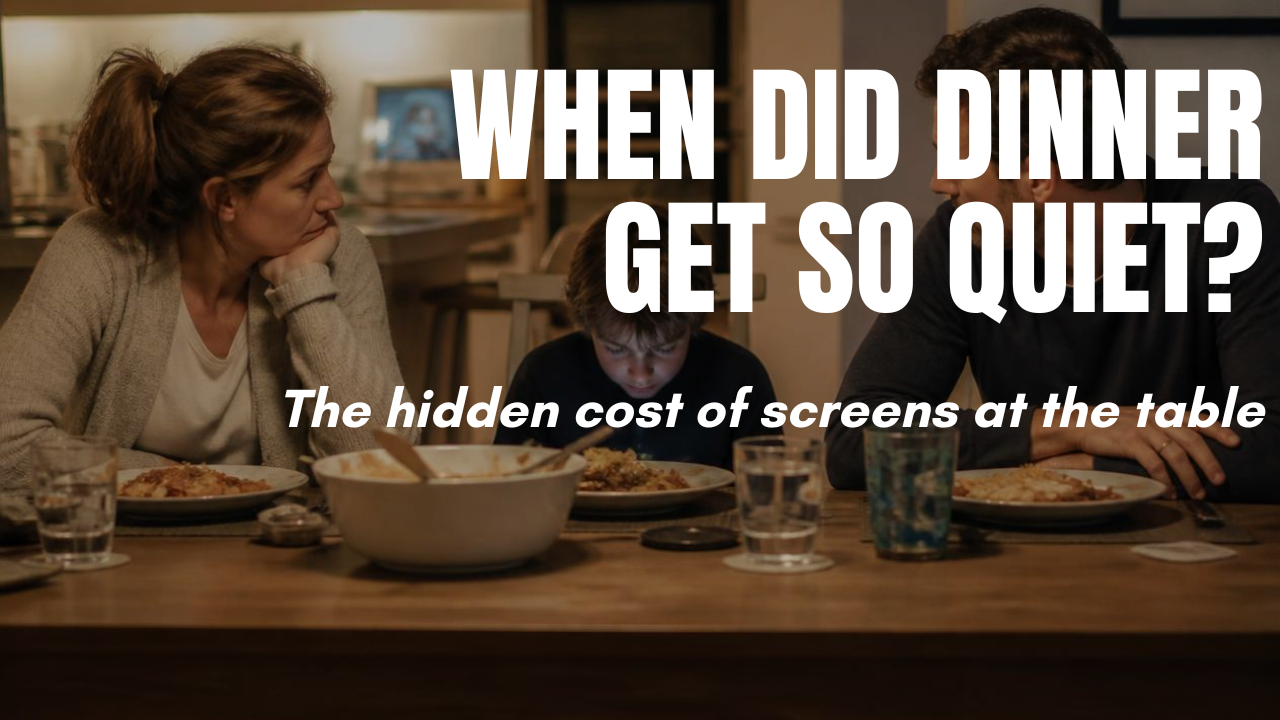
The Silent Mealtime: What's Really Happening to Family Connection
If you've ever had to call your child's name three times before they looked up from a screen, this one is for you. It's not a rare moment anymore. It's most nights, in most homes, no matter how good a parent you are. It's a pattern showing up in households everywhere, which is exactly why it's worth talking about honestly, along with what has genuinely helped the families going through it.
Why does raising kids today feel so different from a generation ago?
The kids growing up right now are living through something no generation before them went through. Tablets before they can properly talk, social media accounts before high school even starts, and a constant stream of notifications pulling at their attention from the moment they wake up until well past when the lights should be off. For parents, this isn't some abstract worry read about in an article and then forgotten. It's the actual texture of daily life. It's the breakfast table where nobody's really talking. It's the car ride home from school that used to be full of chatter and now happens in near silence. It's the bedroom door closed a little earlier each year, not out of rebellion, but because the screen inside is simply more interesting than what's happening outside it.
Why do so many parents feel like they're figuring this out alone?
Because in a lot of ways, they are. Most parents have no reference points for any of these. Their own parents never had to compete with apps built by teams of engineers whose entire job is to keep a young mind scrolling for as long as humanly possible. There was no version of childhood before this one that looked anything like it does now. So, most parents end up working off instinct rather than experience, second guessing themselves constantly. They want their kids to keep up socially, to not feel left out among their friends, but they're also lying awake wondering what all of this screen time is quietly doing to their mood, their sleep, and the way they see themselves. That tension is real, and it doesn't get talked about enough.
What does this actually look like inside a normal family day?
It's rarely one big dramatic moment that signals something wrong. It's smaller than that, and it sneaks up on families. It's the dinner interrupted by a buzz that nobody can quite ignore. Its bedtime pushed back another twenty minutes because there's always one more video, one more level, one more message to reply to. It's the conversation that used to happen naturally, face to face, now happening through a screen instead, with everyone quietly in their own world at the same table. None of these moments feel significant on their own. But they stack up, week after week, until the distance between parent and child has grown wider than anyone intended, without either of them really choosing it.
Is the answer to just take the devices away completely?
Not really and pretending otherwise doesn't help a single family. Screens are part of how kids learn, play, and stay connected to their friends, and removing them entirely isn't realistic for most households. The families who manage this well aren't the ones fighting technology every single day and losing. They're the ones who've picked one or two windows in the day, dinner, the drive home, the last twenty minutes before bed, where the phone is genuinely put away, and full attention is given instead. It's not about winning a battle against technology. It's about protecting a small pocket of time a child can count on, every single day, no matter what else is going on.
Where should a parent start?
With an honest look at where things currently stand at home. Take the quick quiz to find out if your kid is addicted to technology.
Take the Digital Daze Quiz: https://www.digitaldaze.com.au/quiz